TwistLock Dynamics Blog
How to Move a Shipping Container Without a Crane
Repositioning a shipping container usually means one phone call: to a crane operator or a forklift rental company. That call is expensive, it depends on someone else’s schedule, and for a single container on a job site, storage yard, or private lot, it’s often overkill.
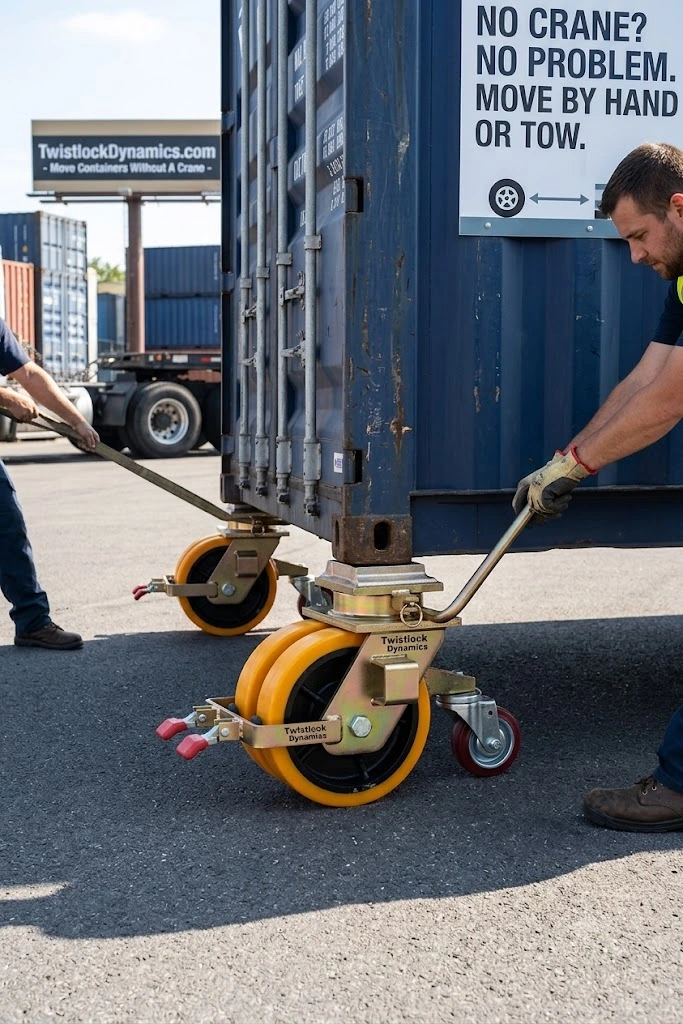
There is a simpler option. Twist-lock caster wheels clip directly into the container’s existing ISO corner castings — the same fittings a crane already uses to lift it — and let one or two people roll the container into position on firm, level ground. No welding. No drilling. No crane booking.
This guide walks through when that approach works, how it works, and what to check before you buy a wheel set.
Why a Crane Is Often Overkill
A crane makes sense when a container needs to travel a real distance, cross uneven terrain, or go up and over an obstacle. But a large share of container moves are much smaller than that: shifting a container two meters to clear a driveway, rotating it to face a different direction, or sliding it off temporary blocks onto a permanent foundation.
For that kind of short, straight-line repositioning, a crane brings costs that don’t match the job:
- Rental and operator fees, often billed by the half-day even for a ten-minute job
- Scheduling delays — cranes need to be booked, and access routes for the crane itself need to be planned
- Site access requirements — a crane needs its own clear approach and stable ground, which isn’t always available on a tight lot
Caster wheels remove all three. Once mounted, the container can be moved whenever it’s convenient, by whoever is on site, without arranging outside equipment.
How Twist-Lock Caster Wheels Work
Every ISO shipping container has four corner castings on the bottom — the standardized fittings (ISO 1161) that cranes, ships, and trucks use to lift and secure it. Twist-lock caster wheels use those same fittings.
Each wheel unit has a twist-lock pin that inserts into the corner casting and rotates a quarter turn to lock in place, the same motion used to secure a container onto a chassis. Once all four wheels are locked in, the container’s full weight rests on the casters instead of the ground, and it can be rolled or towed.
Most systems include:
- A directional lock, so the container tracks straight instead of drifting off course
- A brake, to hold position once the container is where you want it
- A load-rated wheel and axle, sized to the container’s weight when loaded
Step-by-Step: Mounting and Moving a Container
- Check the ground. The surface needs to be firm and reasonably level — asphalt, compacted gravel, or concrete all work. Soft or uneven ground will make the container hard to control once it’s rolling.
- Lift each corner slightly. A bottle jack or similar is normally enough to lift each corner just far enough to fit the caster underneath.
- Insert and twist-lock each wheel. Line the pin up with the corner casting and rotate to lock, the same way a crane’s spreader bar locks in.
- Lower the container onto all four wheels and confirm each one is locked before moving anything.
- Release the brakes and move the container, either by hand for lighter/empty containers or towed with a vehicle or small tractor for heavier, loaded ones.
- Re-engage the brakes once the container is in its final position.
Which Wheel Capacity Do You Need?
The right wheel set depends on the container’s loaded weight, not just its size. As a rough guide:
200+
Satisfied Customers
25+
Years of Experience
5+
Countries Covered
Our Big Clients!

Alice Howard
Lorem ipsum dolor sit amet, consectetur adipiscing elit. Ut elit tellus, luctus nec ullamcorper mattis, pulvinar dapibus leo.
What distinguishes us?
Is our dedication to your success. Supported by an international team committed to customer service across the US, Canada, Europe and China, we’re always here to assist you. Our expertise even extends to custom polyurethane formulations, meticulously crafted for optimal performance in industrial wheel applications.
Let’s delve into how Twistlock Dynamics can drive your mission to deliver groundbreaking solutions to enhance your container transportation experience and streamline the movement of machinery constructed on shipping container frames.
Key benefits of Twistlock Dynamics solutions include:
- Enhanced Durability
- Optimized Maneuverability
- Secure Locking Mechanism
- Versatile Compatibility
- Effortless Installation

