
TwistLock Dynamics Blog
Types of Twist-Locks for Shipping Containers
“Twist-lock” gets used as a catch-all term, but it actually covers several distinct fittings, each built for a different part of container handling — stacking on a ship, securing to a chassis, or mounting a caster wheel. Mixing them up is a common source of compatibility mistakes. Here’s how they differ.
What a Twist-Lock Actually Is
At its core, a twist-lock is a coupling device that fits into the standardized corner casting (ISO 1161) found on all eight corners of a shipping container. The pin inserts into the casting and rotates a quarter turn to lock, connecting the container to whatever is underneath or beside it — a chassis, another container, a crane spreader, or a caster wheel.
The ISO 1161 corner casting is the constant across all of these. What changes is the mechanism that locks into it.
Automatic Twist-Lock
An automatic twist-lock locks itself when the container is set down under its own weight, without anyone manually turning a handle. It’s commonly used on ships and chassis where speed matters and manually locking each of dozens of containers isn’t practical.
- Locks on contact, unlocks with a lever or remote release
- Common in stacking and rapid chassis-securing applications
- Faster to use, but generally not the type used for caster wheel mounting, since caster systems need a controlled, deliberate lock rather than a drop-and-lock action
Semi-Automatic / Manual Twist-Lock
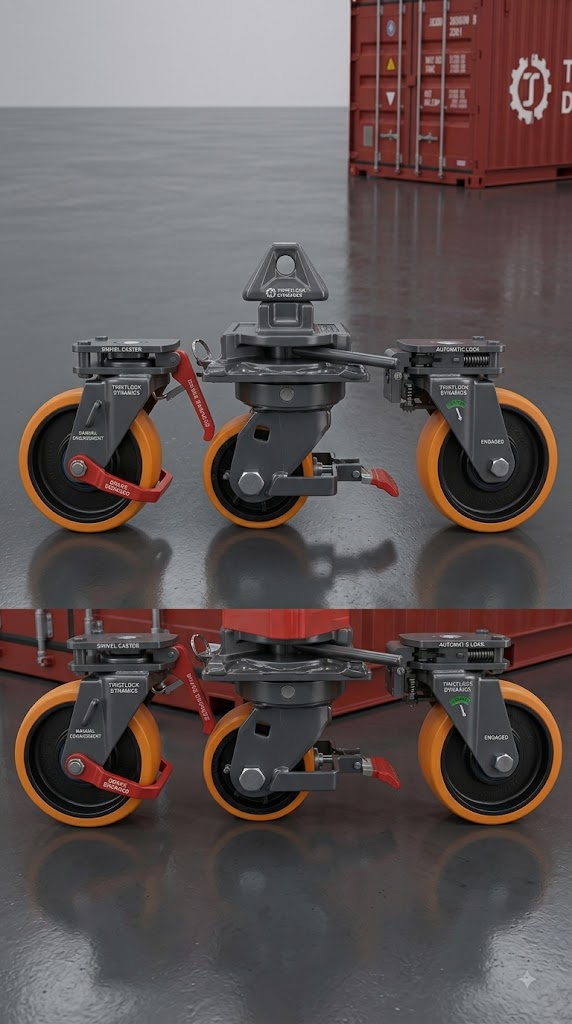
A manual (or semi-automatic) twist-lock requires someone to physically rotate the lock into place, typically with a lever or bar. This is the type most caster wheel systems use, because it gives full control over when the container is locked and released — important when the container’s entire weight is about to rest on the wheels.
- Requires a deliberate quarter-turn action to engage
- Standard on most container caster wheel systems, including twist-lock casters
- Easier to inspect visually to confirm a full lock before moving the container
Bottom Twist-Lock
“Bottom twist-lock” refers to the locks used specifically at the bottom corner castings of a container — as opposed to top twist-locks, which connect containers stacked above one another. Bottom twist-locks are what secure a container to a chassis, flatbed, or caster wheel base, since all of these connect at the container’s base rather than its top.
This is the relevant category for caster wheel mounting: a twist-lock caster wheel engages the bottom corner castings the same way a chassis twist-lock does.
Side-Lock Systems
Some heavier-duty caster systems (like Pro SL and Xtreme-class wheels) use a side-lock mechanism instead of, or alongside, a standard twist-lock. A side-lock clamps into the corner casting from the side rather than rotating a pin vertically through it, which can give a more rigid connection under very heavy, uneven, or high-torque loads.
How This Relates to Caster Wheel Compatibility
If you’re buying caster wheels for a container, the practical takeaway is:
- Confirm your container has standard ISO 1161 corner castings — nearly all standard shipping containers do
- Manual/semi-automatic bottom twist-lock mechanisms are what most caster wheel sets use to attach
- For heavier loads, a side-lock design may offer a more secure connection than a standard twist-lock alone
Getting this distinction right before buying avoids the most common compatibility mistake: assuming any “twist-lock” wheel will fit any container, when the real variable is usually load rating and lock type, not the corner casting itself (which is standardized).
200+
Satisfied Customers
25+
Years of Experience
5+
Countries Covered
Our Big Clients!

Alice Howard
Lorem ipsum dolor sit amet, consectetur adipiscing elit. Ut elit tellus, luctus nec ullamcorper mattis, pulvinar dapibus leo.
What distinguishes us?
Is our dedication to your success. Supported by an international team committed to customer service across the US, Canada, Europe and China, we’re always here to assist you. Our expertise even extends to custom polyurethane formulations, meticulously crafted for optimal performance in industrial wheel applications.
Let’s delve into how Twistlock Dynamics can drive your mission to deliver groundbreaking solutions to enhance your container transportation experience and streamline the movement of machinery constructed on shipping container frames.
Key benefits of Twistlock Dynamics solutions include:
- Enhanced Durability
- Optimized Maneuverability
- Secure Locking Mechanism
- Versatile Compatibility
- Effortless Installation
 Dutch
Dutch  English